If you cannot show it, it is not done

Every result has to answer four questions: which requirement, which configuration version, under what conditions, and what it supports. Simulation, methods and verification are presented separately, never blended.

Mission simulation Mission simulation and research

Mission simulation checks reach, task order, support and contact conditions. Its conclusions depend on the model and assumptions and are not hardware or in-orbit verification.

Mission simulation
1.5× · Sped up; not the real task pace · On-screen subtitles are in Chinese

S7 surface relocation and fastening

Alternate anchoring on cooperative interfaces, relocation, tool and module handling.

Mission simulation
1.25× · Sped up; not the real task pace · On-screen subtitles are in Chinese

In-bay inspection

Reach in confined bays, viewpoint selection and task order.

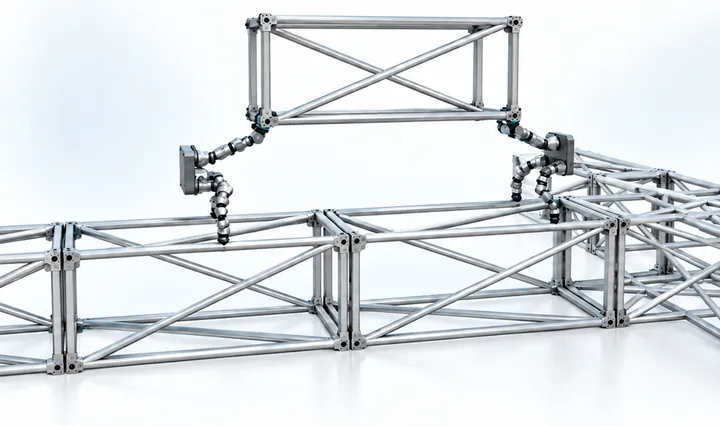
Two arms anchored on either side of a truss jointly hold a truss unit for alignment and joiningConcept render

Multi-arm truss assembly

Concept for coordinated handling, relative alignment and structural joining.

Sensing, manipulation and control

Bio-inspired manipulation

For low-power fine manipulation that does not depend on precise initial positioning: we break tasks into an observe–act–check loop, package grasping, docking and assembly into reusable skills, and use contact constraints to converge on alignment.

  • Less dependence on initial positioning
  • Skills and compute activated on demand
  • Errors corrected during the operation

Motor-level active compliance

Task-level stiffness, damping and force are mapped onto joint torque loops and motor current loops, so contact can be sensed and adjusted. Current, temperature and state protection at every level limit abnormal loads.

  • Adjustable contact
  • Disturbances sensed
  • Safe exit on anomalies

Systems and verification method

From requirement to evidence, every link leaves a record.

  1. Requirement

    Object, operation, environment, acceptance

  2. Configuration

    Robot, tools, interfaces, software version

  3. Task steps

    Entry conditions and anomaly handling per step

  4. Evidence

    Conditions, data, conclusion, scope

Experience from earlier space projects in interface integration, test organisation and data traceability now feeds our product verification process.

Exploratory research Exploratory research

Approach, capture and load-bearing hold of non-cooperative targets

Studying approach to and capture of rotating targets, and carrying load after capture. This is capability research, run separately from the near-term hosted-robot route, and is not a current service.

Attachment, tools and material handling on planetary surfaces

For asteroid and similar surfaces: attachment, contact tools and material transfer. Natural surfaces and cooperative interfaces are treated separately and need joint verification with research teams.

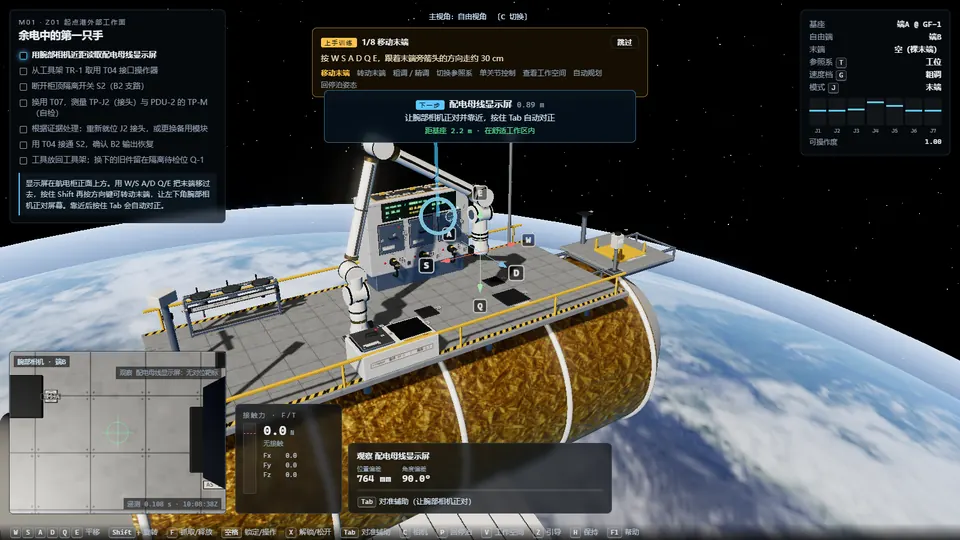
Game screen: the arm working on an orbital node platform, mission steps on the left, wrist-camera inset and force/torque gauge belowGame footage

Interactive

Orbital Works

Want to try base switching and force-controlled insertion yourself? Orbital Works is a space-engineering game we built around our dual-ended seven-axis arm.

About Orbital Works

What on your platform needs a pair of hands?

Tell us the object, the platform and where your project stands. Together we turn it into a task description, an interface list and a verification scope both sides agree on.