Which jobs on a space facility need a robot

We define robots from the work a facility actually needs done. Our three near-term mission classes come from inspection, servicing and assembly needs on orbital computing infrastructure; all three are at concept-study and simulation stage.

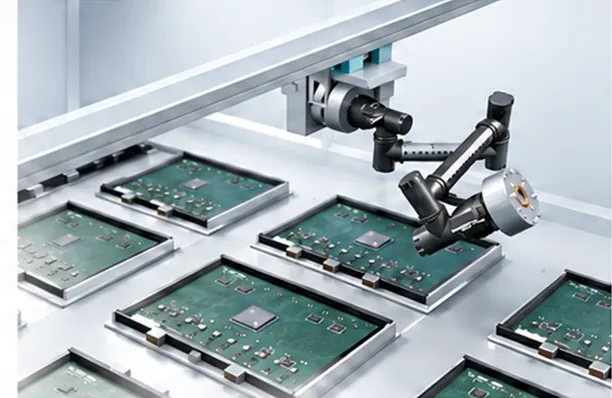
In-bay mission system configuration: a compact arm working between densely packed circuit-board unitsConcept render

Internal inspection and operations

Equipment is packed in tight, people cannot get in, and sight lines are blocked everywhere. The robot has to read status, find the work site and operate in a cramped space. Where it mounts and what it can see have to be defined with the platform owner.

Why it is needed

Bays are densely packed and people have little or no access; the robot must find work sites despite occlusion and confirm status from several viewpoints.

What the robot does

  • Choose viewpoints that cover the target equipment
  • Reach work sites in confined space
  • Re-check anomalies from multiple views
  • Run constrained operations in task order

Current stageConcept study · mission-flow simulation

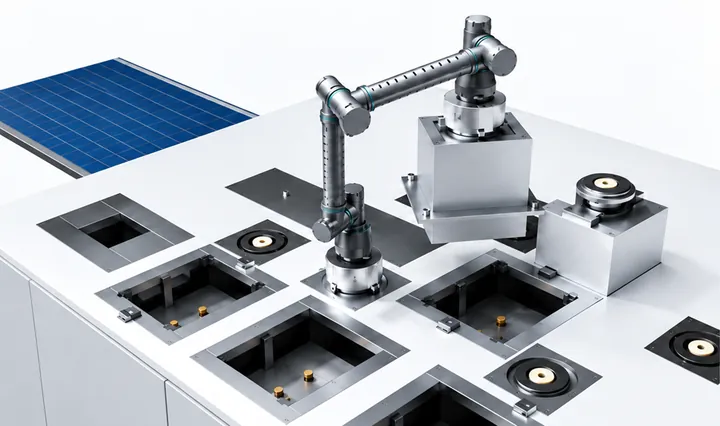
S7 arm anchored at one end to a cooperative interface on a facility surface, the other end handling a module, with tool stations and interface sites around itConcept render

Surface mobility and servicing

The platform is still good; one module has aged. The robot walks over on cooperative interfaces, anchors, and swaps it out. Work sites and interfaces have to be designed with the mission owner so the facility is serviceable from day one.

Why it is needed

Platforms outlive their payloads. Keeping the platform and replacing modules preserves the value of the whole asset.

What the robot does

  • Relocate by alternate anchoring
  • Start load-bearing work after lock confirmation
  • Transfer, insert, change tools and fasten
  • Return tools and restore a safe pose

Current stageConcept study · mission-flow simulation

See the surface-servicing mission
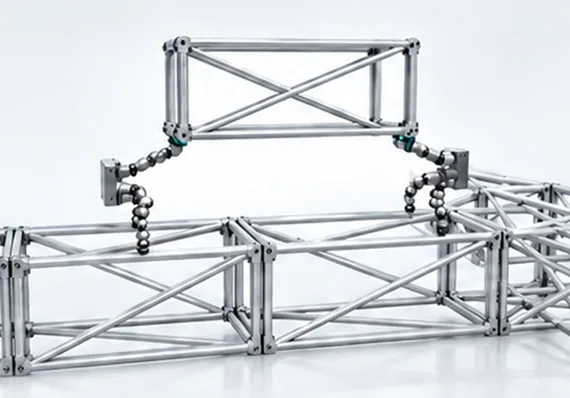
Dual-arm assembly configuration: two arms on a truss carrying a structural unit togetherConcept render

Multi-arm assembly and construction

The structure is too big for one launch, so it is put together in orbit. Several arms carry, align and join it together, without fighting each other.

Why it is needed

Large structures exceed a single launch envelope and must be assembled in orbit; when several arms hold one part, internal loads in the closed chain must be kept in check.

What the robot does

  • Share load while handling
  • Align relative to structural units and interfaces
  • Compliant joining with bounded internal force
  • Lock and verify the joint

Current stageConcept study · multi-arm simulation

Joint missions and space experiments

Open to partners

Defining space experiments that need a robot

We start from the science question: why it has to happen in space, what the robot does, how samples and instruments work together, and how the process is recorded and the result checked.

Resources and flight opportunities are determined through joint study; we have no in-orbit experiment slots to offer today.

Discuss a joint experiment

Shared ground test capability

Design concept

Building reusable ground mission scenes together

Manipulation, assembly and system integration need ground conditions close to the mission: offloading and support, mock-up work sites and interfaces, and process data capture. We want to plan these with mission and research partners.

This is at design stage; there is no completed public test facility yet.

Discuss test capability

What on your platform needs a pair of hands?

Tell us the object, the platform and where your project stands. Together we turn it into a task description, an interface list and a verification scope both sides agree on.